This is a transcript of the Bob Murphy and Adam Haman podcast that was posted on YouTube on August 21, 2026. These guys are great economics educators and I recommend their videos. The transcript follows this video:
0:31 Haman: So we did a podcast about the debt held by the public, and when you add it all up, it’s headed towards $40 trillion. It’ll be there by the end of the week, I assume. Then we did an episode about fiscal dominance. That sure seemed bad, and bad in a soon way: months, not years, sort of a way. And now I hear this story that I don’t even understand about the Fed or the Treasury, or both working in concert to save the Japanese yen. And the Japanese yen has a decades-long underpinning of a financial trade sort of thing. There’s a fancy name for it where you borrow that thing for basically nothing and then go buy virtually anything and pocket the difference. And that’s about to unwind and make the earth explode. So first, could you explain what’s going on with that yen thing and then make me feel like there’s a reason to not gouge my eyes out before I go to sleep?
Murphy: Okay. Yeah, and I picked this happy shirt just to show like, hey, hey, it’s all right, everybody. Chill out. Don’t worry. I think the debt held by the public is the $32 trillion one. It’s the gross federal debt that’s breaking 40, I believe.
Haman: Yep, I hope that’s what I said, that’s what I meant.
Murphy: Okay. Um, so yeah, the, the big news folks, um, we’re recording this in mid August is the ramifications of a massive intervention in the Japanese currency markets. So I think it was, I think like the last two days in July and then it spilled over into August, I believe, the Japanese authorities came in and they spent roughly. So we don’t know the official numbers as of right now because it’s not been released, but the guys at Goldman Sachs are telling us, “oh, we’ve monitored this and we can indirectly estimate, blah, blah, blah”. But it looks like about, they spent, it was measured in yen as they’re doing it, but like reportedly about $85 billion worth of propping up the yen against the dollar, right. So in other words, the Japanese authorities are sitting on a boatload, like a trillion dollars worth of dollar foreign currency reserves. And so what’s the point of having that? Well, amongst other things, if your own currency starts slipping against the dollar, you can sell your dollars to buy your currency and that makes your currency strengthen against the dollar, right. So they did that about $85 billion over the course of those first two days. To give a frame of reference, that was the biggest two-day intervention since 2011 when they had the tsunami in the Fukushima power plant stuff going on. So anyway, this is a big deal. And then also it’s significant that, yes, the U.S. authorities also coordinated with them. And I’ve seen people I think this is how to parse the different statements.
Some news reports say the last time. U.S. authorities worked in tandem with the Japanese to intervene in the yen, U.S. dollar exchange rate was back in, I think, 1998. But then other ones say “not since 2011”. And I think the distinction is in 2011, it was like a G7 initiative to help the Japanese with their currency and everything amidst their natural disaster. Whereas the 1998 deal, it was just the U.S. and Japan. I think that’s how to make sense of all these claims. But in any event, it’s been a while since you’ve seen something of this scope. So let me, if I may, Adam, just to give some context here, share my screen:
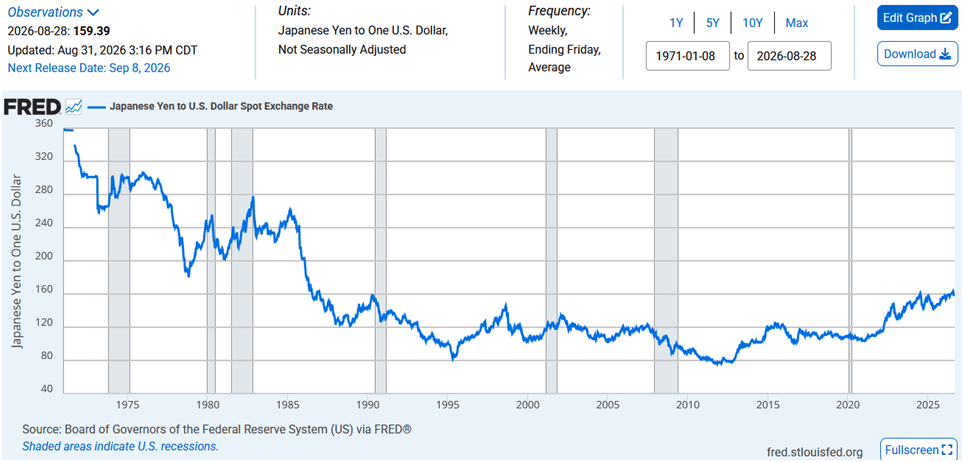
This is Japanese yen to the U.S. dollar exchange rate going back to the early 70s. So the Y axis here is Japanese yen to one U.S. dollar. Right. So the way this works is that the higher you are up on this line, that means it takes more yen to buy one dollar, so the yen is weaker. And as the line moves down, that means the yen is strengthening against the dollar. So you can see, like back in the early 1980s, it was between 200 and 240. And then starting in 1985, it falls off a cliff. And they had done, you know, there was some agreement they made and everything back then in order to deliberately have the dollar weaken against the yen. So the yen strengthened considerably, is bouncing around, you know, over the decades between, let’s say, 80 and 130 or whatnot, and then largely between 80 and 120 in recent decades. And then you can see, Adam, that oops, starting in like 2022ish, the yen starts weakening and then it breaches in recent years. And now, you know, just lately, this 160 line, right. So 160 yen to the dollar is kind of like a threshold because you can see, you have to go way back. So where we are in recent times, the yen has not been that weak against the dollar since the mid-80s, right. So that’s why people are saying this is like the yen had been hitting 40-year lows. And so that’s why the authorities started doing what they did in late July is because they realized like the yen is too weak now, “We got to come in and try to bolster it”. And then just let me show you one more here, Adam, to give the context.
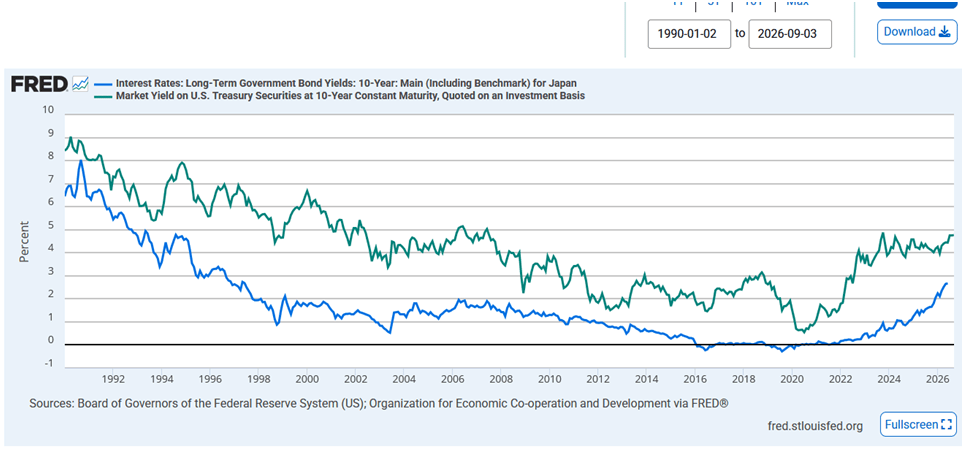
Okay, so this one, it’s showing the 10 year bond yield for the U.S. and Japan, you know, for the federal central governments. In the green line is treasuries and the blue line is JGBs, Japanese government bonds, right. And again, these are all both the 10-year yields. So you can see, you know, back in this chart starts in the early 1990s. So back then they were up there in the, you know, 6% to 9% range, steadily declining over time.
And then they just kept going down and down such that by 2016, you know, treasuries were trading between 1% and 2%, the 10-year, and the Japanese was literally like at zero and even negative for certain blips there. All right, and then again, this is nominal. This isn’t an inflation adjusted, right.
So this is, people were paying the Japanese government, you know, to take their money. In other words, they were lending yen to the Japanese government and getting fewer yen 10 years later, right, that’s what a negative interest rate means. So and then you can see what happened is that they started rising. Well, this is an important part of the story. The U.S. started raising rates earlier, right, so you can see in 2021, 2022, the green line’s moving up there rapidly, whereas the blue line wasn’t at first. And so just think back to the context. What was going on is, remember, we here in the U.S. were hitting 40-year highs in consumer price inflation, because, you know, the lockdowns and everything, and the Fed was dumping all those boatloads of money in the system. And so then the Fed had to start raising rates and that the Fed raising its policy rate also, you know, translated through to 10 year yields rising. And so for a stretch there, it exacerbated the so-called “carry trade”. I’ll talk a bit about that in a second, but I just want to make sure people are getting what happened here, that as the 10 year yield in the U.S. was rising, but initially, like in early 2022, the Japanese 10-year yield was still at zero. Now that even intensified people doing the yen carry trade, which involves borrowing in yen, selling yen for dollars, and then putting it in treasuries and earning that spread. And so you can see as the U.S. started raising interest rates and at first the Japanese hadn’t, that’s just going to increase that spread that you’re earning so more people are going to intensify that cary trade, and, you know, sink in their positions, so that’s going to weaken the yen even further. So, you see what I’m saying, Adam? Remember the yen started really weakening again and rising up towards the 160 back in, 2020, 2022, 2023. And I’m saying that this is part of the explanation as to why that happened, the timing of it.
Haman: So before we move on, how big is this problem? And what happens when it unwinds?
Muphy: So, there’s different estimates of how big the yen carry trade is. I think a trillion is a nice round number people throw around to show how deep it is. So let me just explain, like “Who cares? What’s going on?” So the carry trade, again, the deal is when Japan has had rock bottom interest rates for a while, and they’re considered a very safe country. They were mired in deflation, and this is part of the story, you can help me unravel, Adam, is that for a long time when people in the U.S. were worried about QE and, oh, jeez, Bush and now Obama and then Trump are running up these massive deficits. This is crazy. The dollar is going to crash. And they’re saying, “no, Japan’s been running massive deficits forever. And they’ve been doing rounds of QE and their debt to GDP is over 200%. So what are you talking about?”
Haman: 250% almost or something like that, depending on how Grok measures it.
Murphy: Yeah. Yeah. Like the one, the Fred chart shows about 220%. And I don’t know if that’s debt held by the public or it just says central government debt in Japan is about 220% of GDP the last I checked. So there’s a couple of things interesting there. But one is that I always thought that was a weird defense. Like, in other words, the Keynesians were saying, “hey, who’s to say that we can’t have a lost decade and we can have our economy be in the crapper for, you know, 20 years. But the currency wouldn’t collapse.”
So it’s a weird defense of their policies. It’s not like their policies ever actually work. It’s not wrong for the reason you said. So there’s that element. But now it looks like even that is unraveling. But anyway, just to circle back, when that was happening, that’s what set in motion the so-called yen carry trade. Because again, people could borrow at zero and then go and best even like in treasuries that are making a pretty decent return. And the only risk from that is like you would be worried about you wouldn’t do that like with Zimbabwe or something if they had pushed their rates down low because you’re worried, oh, you know, what happens? Anyway, actually, maybe you wouldn’t care because of the currency crashes, you’re fine. But in general, you got to be careful about that kind of stuff. But with Japan, because they were a pretty stable country, it seemed like, no, as long as you’re keeping your trade like short term and you can unwind it if you needed to. It seemed like you could get in and out and earn that spread.
And but so now what happens is they start raising interest rates in Japan and now that’s eaten into your spread or, if like the authorities come in right now and start strengthening it, well, then if you were someone who got into your your carry trade, when the thing was particularly weak and now they strengthen the currency that could wipe out your gains, right. Because again, you’re borrowing in yen, selling yen against dollars, say, or, you know, people are doing it in Australian bonds and things like that, but, you know, selling it into some other currency where interest rates are higher and they can be on safe things too, it’s not like you have to get into some speculative deal. It’s just like, no, this is, I’m just, I’m just doing, you know, cross country interest rate arbitrage here. But then the point is, to unwind it, you have to get the payment in that other currency and then go from that currency back to yen to pay off your yen-denominated loan. And so if the yen strengthens while your trade’s in place, that could hurt you. That could eat up the arbitrage from the interest rate spread you were making. So that’s another thing that happens here. And again, with a lot of these things, it’s like a self-fulfilling, not self-fulfilling, but it’s a snowball effect where if the authorities come in and strengthen the yen, such that a bunch of hedge funds and whatever start trying to cover their shorts, by them doing that, they strengthen the yen even more. And then they could put other people in trouble who had a higher threshold for pain. You get what I’m saying? So there’s a lot of these things where it’s like, if something starts going, it can really start ripping. But in any event, yeah, I’ve seen figures saying that the carry trade could be like a trillion dollars. And so again, if the thing is like that starts unraveling and then it happens quickly. One other addendum is, it’s not just international investors doing it originally like I’ve seen analysts say. When Japan first had its rock bottom interest rates, what was happening is it was the Japanese people themselves and institutions looking around the world saying, hey, we “we can’t invest here at home. We’re earning zero percent.” And so it was they were the ones that were taking their currency, selling it against other currencies to get into some other assets that were, you know, elsewhere.
Haman: Is it still true that privately that culture tends to be a high saving society?
Murphy: Yeah.
Haman: So if you’re not in a hedge fund and you’re not involved in this and this all came unraveling, what would be the effect for the average Joe?
Murphy: Well, I mean, so it’s, it’s bad for the Japanese or they’re in a pickle. This has a lot of ramifications and similarities to what we were talking about, I don’t know if it was the last episode or the one before about fiscal dominance and all that stuff, because again, the Japanese government is in debt something like, you know, 200 plus percent of GDP and you just saw. So if they’re, if the interest rate on their bonds went from 0% that not long ago to you know, 3% now that’s a huge difference in annual interest expense, right. And so not in terms of dollar amounts, but just, you know, relatively speaking, just like here we were saying if interest rates go up one percentage point, it’s like an extra $320 billion annually. So to them, their debt burden is twice as high as ours. So in terms of like relative to GDP and everything, that’s just a humongous increase. So they’re in trouble. And I didn’t show it here, but partly what was driving and why did they have to act and not just say, oh, “well, who cares? Why don’t we just let the yen sink further? Isn’t that good for exports and blah, blah, blah.” It’s because consumer price inflation finally kicked in in Japan. So this is another weird thing with the Keynesians. It’s like for in the mid 2000s, the problem with the Japanese is, oh, we have deflation. Like they were like literally there were periods where the CPI was falling over long stretches. And so Keynesian’s like, “man, we just we can’t get people to spend like we even have negative interest rates.” And they literally folks had like banks and stuff like that. And they would have to come up with techniques because you could say, like, why wouldn’t you just pull your cash out and hold it and earn zero? And they were doing stuff like, like measuring your historical average balances, and that’s how they were going to charge you.
And you could say, well, wouldn’t you just take your money? Well, yeah, but then you can’t use the bank anymore. You know what I’m saying? Like they would do weird tricks like that to say, if you’ve been banking with us for a while, we’re going to ding you on the interest expense based on your historical balances if you want to keep banking with us, period. So anyway, there’s all kinds of weird, crazy stuff that economists used to think, negative nominal interest rates were literally impossible. And it turned out, no, there’s ways they could come up with it. And so what’s funny is for a while, like we were just like, “what more do you need to see? The Keynesianism doesn’t make any sense. They literally are having negative interest rates. It’s quote, not working”, but it now is getting to the point where, yeah, okay, finally they do have price inflation and they’re realizing, oh, some of this I think has to do with the stuff going on in the Middle East and Japan is very reliant on Middle Eastern oil and stuff like that. So there’s a lot of things coming together in terms of the timing, but for a lot of this I think it’s the kind of thing where yeah, they pushed it a lot longer and farther than hard money types might have thought. But at some point, you can’t have debt to GDP that’s infinity. Like at some point, something’s got to break.
Haman: And Keynesians just poo-pooed the lost decade or decades or however long it’s been?
Murphy: Well, right. They just show they didn’t do enough.
Haman: Yeah, of course.
Murphy: But also the fact that, like I said, you didn’t have hyperinflation. So clearly, “you Glenn Beck types don’t know what the hell you’re talking about because according to you the engine should have crashed and it didn’t”.
Advertisement
Haman: When you were saying Keynesians would point to Japan and say, “see, you guys don’t need to worry. We could spend as much as they are and it’s not a calamity”. I know that our central bank does a lot to help the yen. So if you were to switch it around, like who would be that to us? Who would be the U.S. central bank for us if we started behaving that way?
Murphy: Yeah, a great question. And I was thinking along those lines myself, that because the euro was in trouble. I’m getting my timeline mixed up now. It was after the financial crisis and there was a period where they were during the financial crisis, too, all these swap lines were open. But I think there was a thing, too, even a couple years later, stuff flared up in Europe, and the ECB needed swap lines with the U.S. to kind of tamp down something. And so here, again, like you’re saying, Adam, one way of explaining what happened is, oh, yeah, the chicken started coming home to roost and the Fed and Treasury shot a shotgun up in the air and scared the chickens away, if you want to keep,
Haman: That’s the perfect analogy. Exactly. Perfect.
Murphy: I don’t know anything about how farm animals work, but I think eggs have something to do with my omelets. That’s really,
Haman: Eggs and shotguns, that’s how they’re made.
Murphy: So anyway, but you’re right. And so it’s kind of like we’re not even seeing the full implications or effects of the Keynesian experiment in Japan because, yeah, there is the big brother waiting in the wings to help bail them out.
And so then the question is, all right, what would it look like if this happened to the U.S.? And it is, we’ve seen, you know, implications of that or signals or symptoms of that stuff happening already. Like, remember that Luke Gromen thing where he was saying the U.S. is still the world’s superpower, except, you know, if the markets are open. And one of the things was he said if the 10-year yield gets above, I forget, it said like 5.7 or something. And it was, so, yeah, we are seeing that here. And then it’s true, like with all these other ones, it’s like, oh, well, the problem, like with this one, with Japan, the problem was, oh, yeah, the yen’s falling against the dollar. And so some people might argue, well, “the dollar can’t fall. You know, it’s the baseline. You know, so the dollar’s not going to”.
But no, it can fall against gold and it can fall against goods and services. And that causes a problem. We saw that, you know, in the 2021, 2022. All of a sudden, the textbooks seem to be working again, whereas in 2009, 2010, it looked like, yeah, you can just print boatloads of money and nothing bad happens. So I guess that’s out the window, but the helicopter drops and post-COVID certainly made things get expensive at the grocery store.
Haman: Yes, it did. Alright, I have two questions, and I need to give them to you at the same time because you sort of already touched on the first one, but I want you to give it another pass. What do you think’s been going through the mind of the government or central bankers or whatever in Japan during this whole period of time other than just panic? But then I’d like to know what you think is motivating the U.S. central bankers to, I mean, the quotes were like, “we’ll do absolutely everything, anything to save the yen”. I mean, they were sounding like this is a, this is an existential threat. And so I’m wondering if there’s any clues in there as to why, why they would say that, why they would do that?
Murphy: So I guess probably what was going through the minds of the central bankers was “Domo Arigato”.
Haman: Okay. You’re welcome.
Murphy: I think with all this stuff, The people behind the curtain realize how tenuous their grip is. You know what I mean? I think the person who really knows how weak he is is the dictator, and that’s why he knows, like, no, I have to. If there’s graffiti, we’ve got to get rid of that.
If somebody’s speaking out against me, that guy’s got to be gone because they know I could be out of here next week. The soldiers could turn against me. Whereas to the average person living under the totalitarian nightmare, no, the strong man, he’s invincible. But no, the strong man knows, like, I have to go to sleep every night. If my bodyguards join a coup against me, I’m dead. So I think likewise with this stuff, people realize how much confidence matters and public opinion. Just kind of drawn from your playbook, I was watching Scott Bessent giving interviews on the Japanese stuff, and he’s just sitting there like this.
You know what I mean? He really looks like the Joker almost. It’s such an exaggerated grin on his face, just assuring everybody, “no, no, no, the yen, I think is undervalued right now or whatever”.
Haman: Well, if, I mean, if they did nothing, is the problem that all the T-bills the Japanese government is holding would just come flooding back?
Murphy Yes. Yeah.
Haman: So what would the effect of that be?
Murphy: Actually answer your question. Thank you. I think that’s the third time you’ve had to ask me. Okay. So one thing is, yeah, just in terms of humdrum analysis – things like I’ve seen reports like insurance companies in Japan and other institutional asset managers are sitting on a lot of Japanese government debt.
Like that’s why they’re in that 200 percent of GDP is like there’s lots of companies that loaded up and that stuff thinking, oh, it’s the Japanese government. They’re good for it. They’re safe. And so if that is the interest rates rise on that stuff, like there’s huge capital losses. Right, like, you know, the value of a bond goes down when interest rates go up. So there’s stuff like that, that there’s massive, at least paper losses for a lot of institutions holding that stuff. So that’s one element in terms of when you have to jack up interest rates. And we already said, like the funding problem with their government. But yes, the Japanese are sitting on something like a trillion dollars of Forex reserves and dollar assets. And just like they blew through 85 billion in two days, if the yen kept falling and as of right now, like the consensus seems to be that there was a brief respite, but the fundamentals are still going to move against it. You know, like, yeah, they can. It’s like if the authorities are sitting on the stockpile and they can throw money into a bad trade, they can do it for a bit. But, you know, people hunker down and once it looks like the authorities are backed off, then you’re going to go ahead and try to trade on the fundamentals again. So, yes, to answer your question, they could just keep selling dollars to try to prop up the yen, but that hurts treasuries and that makes our yields go up. And so if the U.S. authorities at some point decide, hey, we kind of don’t want our yields going up that much, that could be a problem.
Haman: So we got that going on. We talked about, I think it was just last week, fiscal dominance, that whole house of cards, $40 trillion in total debt. So all these things, I’m looking for the tsunami outside my window, and I live in Las Vegas. I mean, I guess my question is, if everything goes as bad as it can get, and we don’t know how high oil is going to go, you know, depending on what goes on in the Middle East and elsewhere. There’s wars in Russia, too. I mean, is it the sort of thing where we’re going to go through a rough time, but it’ll be okay? Or do we really need to hope Jesus is coming back to gather us up, or at least you in his loving arms?
Murphy: Yeah, people should go read the Gospel of John. So, yes, like the Middle East, in terms of everything going on, yes. I think part of it is, like, why would the U.S. authorities want to help the Japanese, right. Because it’s kind of interesting, too. And here’s a quirk, apparently, even though the U.S. authorities didn’t do nearly as much as the Japanese did, but it was more of a symbolic thing, like they did a bit, and then like, I think that was like signaling to the markets like, hey, don’t bother fighting this trade because you’re going to lose money. And they said, oh, OK. So there’s like a thing there where it’s like if it’s a credible.
Haman: Yeah, credible bluff.
Murphy: But also specifically, mechanically. I think what they did was they sold. So the U.S. is sitting on a bunch of Forex reserves and different kinds of currencies, and so given that their goal was to strengthen the yen, they didn’t sell dollars to buy yen, they sold euros to buy yen, which is an interesting move. And they didn’t officially talk about why, but like the Goldman Sachs guys and stuff I was looking at, they thought it was more of an optics thing that they just thought the Trump administration would not want to be seen is, like selling dollars to prop up another currency, like that would just look weird. But in any event, that’s what they did. So I think part of it is just did you see Trump’s when he’s getting on a plane and he talked about it? They’re asking him, “why are we doing this, you know, Mr. President?” And he was like, “the U.S. are good allies and they’ve always had our back or whatever, you know, except for Pearl Harbor”.
Haman: Except for that one time.
Murphy: That was great. Anyway, so I think partly, like you say, it’s just uncertainty and volatility that the world is, you know, financial markets, how much they rely on trust and people just thinking tomorrow is going to be like yesterday. And then once you start opening up the box and thinking, well, hey, who said? The U.S. doesn’t want that right now.
Haman: You want to do anything you can to make sure that Wile E. Coyote does not look down.
Murphy: Right, right.
Haman: Because that’s when the problem happens. Stuff is just horrifying.
Murphy: But also, I think you’re right, to point to the Middle East, besides just a general “Hey, we think we’re right in the fundamentals, and the dollar’s been fiat since 1971. And one of these days, people are going to realize we are right”. That kind of thing, which we kind of have been saying that for decades, and we’re not wrong, but on the other hand, it seems kind of weird. But with this, there really is, like I say, with this stuff, you can point to things and say, well, no, I mean, yields are going up. This is crazy. This is not going to work. But yeah, the stuff in the Middle East, they still have not resolved that.
Haman: I know.
Murphy: And it’s, again, with this stuff, it’s like, well “But Murphy, didn’t you think it was going to be more of a problem by now than it has been?” And yeah, but that doesn’t mean we don’t need oil. So it’s and again, I’m not just, you know, keep moving the goalposts or something like I read analysts that know more about this stuff that I do, and it’s not like they’re ideological and, you know, have some reason to hate the U.S. government or something and want to just say that whatever they’re doing is wrong. And I mean, they know that the barrels flowing out of that region are a lot lower than they used to be.
Haman: They’re still hitting ships. Crewmen are still dying. Trump is threatening to drop bombs on, what, Oman now? The Iranians, apparently, are willing to sit Trump out. So we’ll see you in January 2029. I mean, what in the hell is going on here?
Murphy: Yeah, and I just saw a headline the other day saying that the Strategic Petroleum Reserve of the U.S. is at the lowest level since 1983. Right, so, I mean, this is that’s partly like to explain how is this physically possible? Partly it’s because there was a lot like just in the system working its way through that’s been getting drawn down and official government stockpiles they’ve been selling off. So that’s part of the explanation, but they really can’t keep doing that. And we’re basically out of missiles, is my understanding. So it’s it really is kind of like, yeah, they had six months to play with and they did and we’re kind of reaching the end of that.
Haman: Alright, so economist Bob Murphy says, go ahead and raise that time preference because the future isn’t real. I mean, obviously you’re not saying that. I’m trying to draw a firm conclusion out of you and I guess you’re wise to try and squirm away. What’s the firmest you’re willing to go as far as what you think is maybe, at least we should be concerned about as a possibility? How much spam should I go buy this weekend?
Murphy: I mean, I would definitely, too bad we don’t have a promo code set up, PreppersRus/crossover. Yeah, I mean, joking aside, like I have a bunch of that stuff and I buy extra bottles of water, like, you know, the big jugs when I’m at the store or whatever, like thinking, there’s no scenario in which they’re going to say, why did I load up on so much water? Like, that’s not going to, I could just drink it if I want to later and get rid of some of it. Yeah, with the situation in the Middle East, it’s, I’ll say a few things here and stick my neck out. If they don’t reopen that, I don’t see how you don’t have oil prices going significantly higher and that causing massive pain. The U.S., we’re relatively spared from that because we have so much domestic production here. Like it’s still, I mean, it’s fungible, right? So in other words, it’s partly what the reason it helps us is that we’re the like, it’s Americans benefiting from higher prices and like a lot of Americans, their pension funds or whatever, exposed to oil stocks and things. You get what I’m saying? So it’s that element. I don’t mean, oh, gasoline won’t be expensive for us because we have oil here. No, because we would export more. You know, if the global price is high, we export more oil around the world so that motorists around the world can all bid on it. So it’s still going to hit us here, but I’m saying this in terms of like just the economic fallout, the fact that we’re, you know, the biggest world producer of crude, that helps cushion the blow. But yeah, if they don’t get that thing open, this can’t persist. Like prices have to go higher. And I think the only reason they’re still this relatively low is that people keep thinking “this is crazy. Surely they’re going to come up to a day like it’s not good for anybody. You know, the Iranians want to sell oil. Trump wants them to sell oil. So what the heck is going on here?” So that’s that’s the best I got in terms of how come the price isn’t higher already on that element. And then the other stuff that, you know, with this fiscal dominance and all that, like, yeah, it’s, I think we’re at the point where interest rates now, they’re rising. And what’s significant too is the investor, like in the financial press, when they’re talking about why they are starting to more often, like just say matter of factly, investors are getting concerned about how high the debt load is getting.
Haman: Right.
Murphy: You know what I mean? So that used to just be like something that like a Peter Schiff or something would talk about, but it was like, “Yeah, I guess if you looked at the U.S. as like a big company or something, okay, but I mean, come on, it’s the U.S. government, it’s the world reserve currency, and I just think that, or, and the last thing I’ll say on this, I really, I know I keep harping on this, cannot overstate the significance of the U.S. getting spanked by Iran, just even on something like you would think, well, what the hell does that have to do with treasuries or something, but I just think psychologically, like people realize the U.S. is not as powerful as we thought six months ago.
Haman: In the last handful of years, they really screwed up with COVID, they forced people off of the SWIFT system, you know, over the Russia-Ukraine thing and Middle East. They’ve got these other countries trying to, you know, do BRICS or whatever. And then once the military gets denied whatever its objectives were in the Middle East, it’s like, yeah,if the words “global reserve currency” used to just roll off your tongue so you weren’t worried about the U.S. dollar, that just has to be shaken by now, right?
Murphy: Yeah. And the other thing, too, is with the whole Hamilton system, and whether or not that’s what it means. But a big part of that, and I don’t know if you saw it, but at least in my niche circles on Twitter, people have been resurfacing. Like Phil Magnus has been doing this for his own reasons, but JD Vance in 2023 is on some panel for, I forget what the name of the organization was, maybe American Compass, but that could be wrong. Talking about how it’s a blessing, but also a curse that we’re the world’s reserve currency. So there’s, like I’m saying, it’s not just a, uh-oh, we might forfeit this, but there’s people on the right who are openly saying “Yeah, this is partly why we lost all of our manufacturing base and everything we can’t export is because the stupid dollar is a global reserve currency. And it’s, you know, keeping it strong when normally if we had massive trade deficits”, so the argument goes, “the dollar should weaken helping us to restore balance”. So I, do you want to talk through that? But I’m saying whether or not you think that analysis is valid, a lot of people on the right are talking like that.
Haman: Yeah, I want to pull on that thread for sure.
Murphy: So my narrow point is it’s not crazy talk to say we might forfeit the global reserves. Some people are saying, yes, let’s go ahead and, you know, we don’t want to go to that game to forfeit them anyway.
Haman: So if they’re honestly signaling their intentions, what do you think they would do specifically? And then what do you think would be the ramifications, short term and long term and everything?
Murphy: Okay, so first, let me just take a step back. I think we’ve probably talked about it here a little bit, but It’s too quick of an argument, people, they bring up this thing called the Triffin Dilemma.
Haman: Is that from Harry Potter?
Murphy: What is that? I mean, I know Harry Potter is, but okay.
Haman: It just sounds like you’re making up a fake animal.
Murphy: It does. Yeah, it does sound. Anyway, I thought maybe there was a character named Triffin in there. So anyway, it was the allegation goes, and this is like finance bros talk like this a lot. They’ll say, “okay. Yeah, Bretton Woods in the U.S. at the global reserve currency. But, you know, the problem is”, and this guy Triffin pointed it out, he was just, I think he was the first at Harvard, I forget where he was, Columbia or something, and he went and testified famously, I forget when, in the 50s or early 60s, in the government commission explaining this isn’t going to work because here’s why, that because we’re the global reserve currency, for that to work, other countries around the world got to keep piling up their dollar assets, you know, loading up on treasuries because that’s the whole point is we told them, “you don’t need to hold gold, just hold dollars and then we’ll hold the gold. And we just promised dollars as good as gold, right”?
Haman: Pretty good deal.
Murphy: Yeah. So for that to work, the rest of the world’s got to be just be loading up on dollars. Okay. You know, as their economies grow and they, you know what I mean? You’re not just going to have a fixed number, you know, of reserves and whatnot, like your, as your economy grows, the amount of that. So there, so the argument is, the U.S. government has to run deficits and like the U.S. economy has to perpetually run trade deficits because foreigners need to on net load up on dollar assets.
Haman: Cut all the trees, turn it into paper, load it up with ink, ship it out.
Murphy: And so then, oh, well, how are they going to do that? Well, because they got to send us goodies. And so, oh, shoot, now because we’ve taken it upon ourselves to be the issuer of the global reserve currency, we have no choice but to just import more goodies every year than we produce and sell the rest of the world. So that’s the argument. And that’s not right, the actually I’ll make on that just theoretically is it’s even if we’re net exporting treasuries, and so, okay, foreigners got to send us, they don’t have to send us cars and TVs. They could send us shares of stock. They could send us real estate claim. You know what I mean? So yes, they got to send us something valuable in return. We’re not just going to give them dollar claims for nothing, but it doesn’t have to be goods and services. They could send us other types of assets in exchange. So I’m just saying in terms of the accounting, whatever, that doesn’t work. And even the U.S. government itself, they could issue treasuries and get paid in other assets. You know what I mean? They don’t even have to run a budget deficit to be issuing net gross treasuries.
Haman: So if these politicians wanted to implement the Hamiltonian system or something gross like Frankenstein version of it and not be the world reserve currency, would they have 500 percent universal tariffs and strict capital controls to block the other thing you were just talking about? How would they do it? And then what would, I mean, I can guess what the effects would be, but like, what would they even try?
Murphy: Okay. So let me just do one more empirical claim and then I’ll come back to your hypothetical. The other thing that’s so weird about this idea that, oh, that’s why given that we’re the global reserve currency, we have no choice but to run trade deficits is empirically in the Bretton Woods system before 1971. So from 1946 to 1971 also worked. If you look at the annual averages, every single year except one, the U.S. had a trade surplus. No, if you have the global reserve currency, that doesn’t mean you have to run trade deficits, both in theory and in practice. That wasn’t the case. Once Nixon went off gold from 1972 to the present, the U.S. had a trade deficit in all but two years.
Haman: I’m glad you went back to make that point. I did not know that.
Murphy: Yeah, so I think that clearly shows it’s not having the world’s reserve currency that’s the issue. It’s having the world’s reserve currency and being fiat.
Haman: And not sound money, yeah.
Murphy: That’s what, and even there, like theoretically you could do it. It’s just, it’s too tempting, right? So to answer your question, yeah, you could have the, everyone could love the dollar. And if you tied it to gold and had it back to 100% and the federal government ran a modest budget surplus every year, and, you know, you had very stripped down, you know, minarchist night watchman state regulations on your own business and everything. I think, yeah, we would still be a production powerhouse. I don’t know if it would be manufacturing. We’d still be making cars or something, but we might be making spaceships.
Haman: Could you put that handful of bullet points into a memo and send that to somebody?
Murphy: Would they read it?
Haman: No. They’d laugh about it at the Christmas party.
Murphy: So they could do that. And then for people to try to understand, so what would happen is like the dollar would strengthen against every currency, typically year after year. And in the US, though, we might have gentle price deflation. Right, and so that’s the way, like, in case there’s some things that are conflicting, like, “well, how could foreigners afford to buy our stuff if the dollar is so strong?” And it’s because the price of our stuff quoted in dollars would be going down year after year. So, yeah, the dollar would keep strength against their currency, but our stuff would keep getting cheaper, whereas their stuff in nominal terms to them would just keep getting more and more expensive. So American wheat would still be competitive because the price per bushel measured in dollars would be falling, whatever, one percent a year.
Haman: So they’re not going to do any of that. What are they going to do, do you think?
Murphy: Start wars, print money, borrow money.
Haman: Rinse, repeat.
Murphy: Just have, you know, foment culture war stuff to make us focused on that and not the wars and money printing.
Haman: Feed Christians to lions, hope that works out. Which, who do you think is going to get us first? The Visigoths or the Gauls? I don’t remember who the other barbarians were.
Murphy: I know many subjects history is not one of them.
Haman: Yeah.
Murphy: You know what’s interesting, just to show the connection and why “Human Action” is such a masterpiece, is Mises just riffs and he says that, oh, you know why the Romans, you know, why Rome fell? And you say, oh, because the barbarians conquered them. And he says, yeah, but barbarians had attacked them plenty of times. Plenty of times, yeah. And they repelled them every time. He said, how come this, you know, when it fell, how come? And he said, oh, it’s price controls. And his argument was because the price controls, there’s no food in the city and the people go out in the countryside or whatever.
And he’s saying at some point they welcomed the barbarians because they were starving. And it was just like, “yeah, come on in. This system isn’t working”. So whether you buy that or not, because he also had a thing with the Russians in World War II and he just kind of has a like, no, the only reason they could do that is because they were equipped with allied capitalism. Like, without capitalist production equipping the Russians, they would have folded and the Germans would have conquered them. So, anyway, Mises is a very big believer in economics.
Haman: And on that point, just go to http://www.spamluncheonmeat.com/crossover to get that 20% off your first pallet crate of spam luncheon meat. I’m not feeling better. I was hoping you were going to make me feel better, Bob.
Murphy: Well, I mean, what you could do, besides, you know, stocking up on batteries and whatever, is just go find a tech billionaire and befriend him. And then he’ll let you into his gated city that has its own nuclear plant. So he’s going to have his power when the grid goes down. You’re going to have security. He’s going to have 20,000 robots and those like, dogs. Have you seen?
Haman: Mm hmm.
Murphy: I took my kid to the Boston Science Museum and they had a little dog that was walking around. I was like, oh yeah, that’s not freaky.
Haman: So I tell you I’m concerned about the future. You say whore yourself or your wife, Adam, out to Elon Musk. That’s your advice to me?
Murphy: I didn’t say it had to be Elon. That’s a competition, see? That’s what’s good about anarcho capitalism.
Haman: That’s right. Free market in sexual favors for entrance to the volcano lair. Do you have any guesses? Political guesses? I mean, the economics of the next couple of years is going to be terrible. Do you have any, you know, you read the news, what do you think is going to happen here come the midterms and then two years later?
Murphy: So there’s no confidence placed in this stuff, folks, so don’t try to do a gotcha later. I think the Republicans are going to get crushed because I think the economy is going to just continue to weaken. And the Republicans, their argument is, “no, it isn’t. It’s just, oh, things are expensive.” Have you seen this trend now where people are like, who is that guy? Is it the Babylon Bee guy? Joel Berry. Or am I mixing things up? Anyway, on Twitter, he’s like taking photos. “Look, my wife got this for $75. What are we talking about? At the grocery store”, you know, like to show to people complaining about inflation. And I was like, “what are you doing?”
Haman: The exact same people running cover for Biden’s inflation during COVID. It’s so stupid.
Murphy: Well, the flip side. I mean, the flip side.
Haman: Yeah, the behavior is the same. The people, the opposite.
Murphy: So that’s what I mean. If they brought me in as a consultant or something, especially if they were going to do the policies, I would recommend, yeah, you could maybe do something. But no, in terms of Trump, you see the recent speech he gave where “Yeah, $4 a gallon is a small price to pay to keep nukes out of the hands of these psychopaths or whatever, and I don’t apologize for it”. Oh, that’s big of you. You’re okay with us paying $4? Yes, yes, many of you will not be able to get to work, but “that’s a sacrifice I’m willing to make”. So, yeah, I think the Republicans are going to get crushed. But then, you know, it’s like, oh, “well, thank goodness the Democrats are going to be sensible then, right?” No, you got Mamdani doing rent freezes and government-run grocery stores.
Haman: Things are so goofy and bad. Yeah, it’s making the Democratic socialists look good. And how can you blame them when you point to this crony corrupt awfulness and say, see, the free market. This is what you want.
Murphy: Yeah, so, it’s not good. That’s why I wrote the book on secession, I focused on Texas because I think that’s the best place to focus one’s efforts. Not that that’s a cure-all or anything, but again, just to make sure people understand where I’m coming from, I think the dollar is going to crash at some point, kind of going to what we were saying, that nobody can bail out the Fed, and so once this disease or whatever you want to call it spreads to and starts affecting the dollar, that’s it. People are going to flee to gold and Bitcoin, I guess. So when that happens, it’s like this way, you know how we’ve been speculating that probably like Taiwan and other places are like, “oh, I guess Washington can’t really protect us anymore. And maybe we should start making deals with other people and finding new friends.” I think that’s how governors will start to feel in the United States. You know, I mean, when if the dollar crashes in Washington, you know, right now, it’s what’s keeping states in the union right now: a combination of greed and fear.
Haman: Yeah.
Murphy: Right, and so once they realize, “oh, no, they’re not they’re not giving us money anymore or it’s not worth anything. If we just left, what are they going to do?” They’re pinned down. They got mass mutinies. What are they going to do?
Haman: Yeah, there’s always that. And just in case you think politics is going to save us, remember that old adage, no matter who you vote for, you always get King Farquaad. Because we said the line from Shrek before.
Murphy: Oh, I got you. Yeah.
Haman: All right. Any more pearls of wisdom? Do you want to go out on a limb and make any predictions at all?
Murphy: Nancy Mace just got tattoos. AOC is freezing her eggs.
Haman: What are the signs of the coming apocalypse? You read the book. I didn’t read the book, I think it was in there, though. All right. Well, I’ll go sharpen my knives and then go get the store and get some more spam.
Murphy: Okay. I don’t think you’ll regret it.
Haman: All right. Well, thank you, sir, for your learned wisdom. And ladies and gentlemen, we will catch you next time on the, oh, just in case the world doesn’t end, go to my channel https://www.youtube.com/@HamanNature on YouTube. And Bob’s channel. What is it? Bob the Anarchist Guy?
Murphy: On YouTube? It’s https://www.youtube.com/@BobMurphyAncap
Haman: There you go. Go to those things and hit like and subscribe and tell your friends. Or don’t. It doesn’t matter. The world’s about to end. Thanks again, Bob. And we’ll see you next time, ladies and gentlemen. Bye-bye.

 Brandon Coale Notes
Leave a comment